
 EN
EN
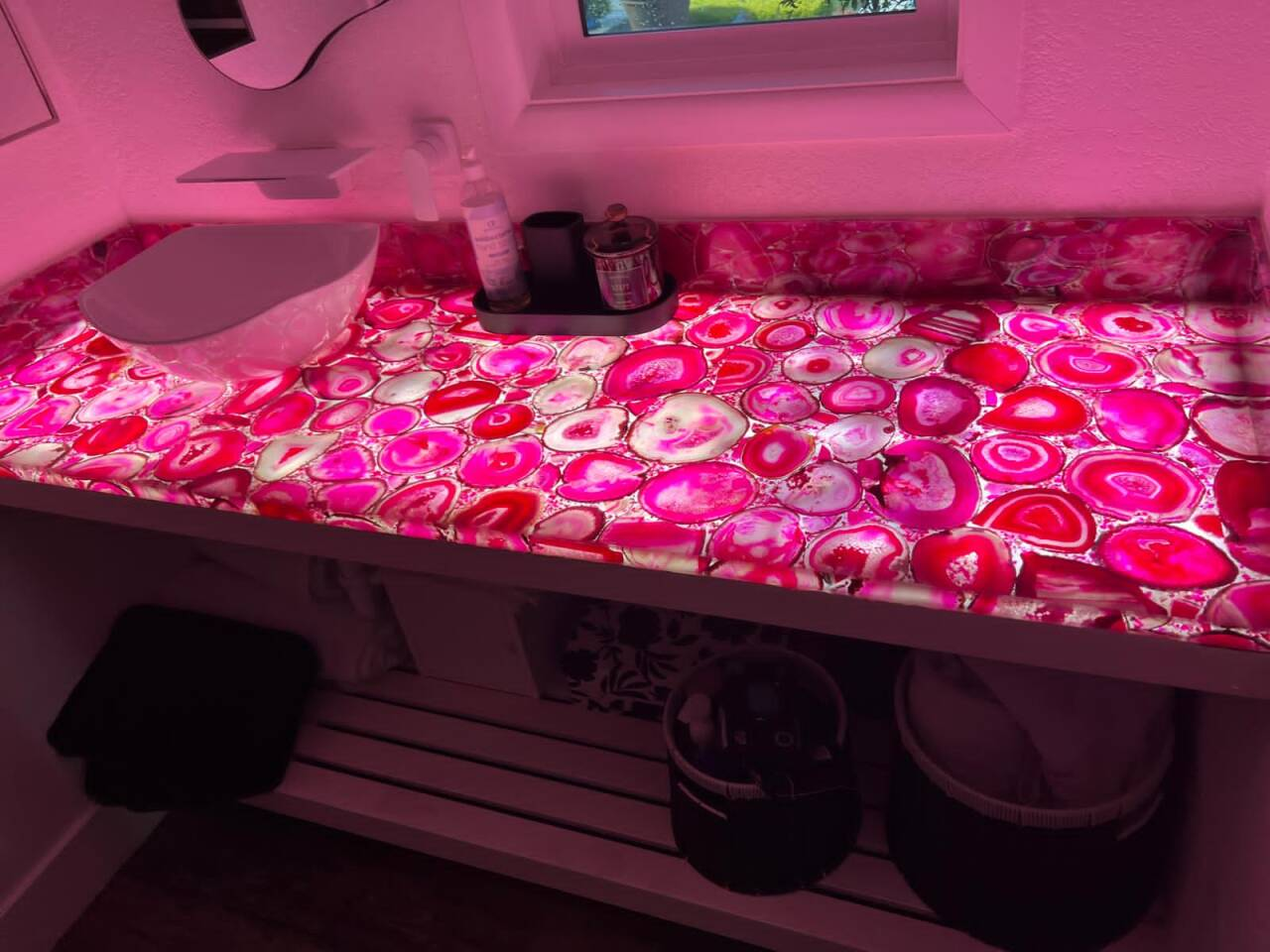
Why Agate Stone Elevates Luxury Interiors
The rarity-to-perception pipeline: How agate's geological uniqueness translates to spatial prestige
Agate takes millions of years to form when silica deposits build up inside volcanic cavities. The result is those beautiful banded patterns that are totally unique and can't be made artificially. This makes agate pretty special in the world of luxury materials. Most people don't realize that only about 3% of all agate mined actually qualifies as good enough quality for interior design applications. When we install these slabs as accent walls or on countertops, every piece becomes like a fingerprint no one else has. Some researchers even call this effect an "aesthetic rarity response" according to a study from the Journal of Environmental Psychology back in 2023. For wealthy clients looking to create spaces that stand out from the crowd, there's nothing quite like having something so one-of-a-kind in their home or office.
Psychological resonance: Calming chromatic gradients and biomorphic patterning in high-stress residential environments
The gentle color shifts in agate stone, moving between warm amber tones and cool blues, plus those natural bands running through it, actually fit right into what we know about biophilic design. Research suggests this kind of pattern can cut down on stress levels around 17% according to that Human Spaces study from last year. The way agate forms reminds people of real nature scenes like rivers flowing or hills rolling across the horizon, which somehow makes them feel calmer inside. Backlighting agate stones in bathroom areas or special meditation corners really brings out these colors, creating something that seems to help relax the mind. That's why so many city dwellers are turning to agate for their homes when they need a break from all the noise and stimulation outside their doors.
Backlit Agate Features: Engineering Light Through Natural Stone
Optical science of agate: Translucency thresholds, banding fidelity, and LED spectral alignment
The amount of light that passes through agate ranges from about 25 to 70 percent based on how thick the stone is and what minerals are present, which allows for some pretty interesting backlighting effects when properly illuminated. To get the best look out of these stones, the LED lighting needs to match the colors already in the agate. Warm lights around 2700K to 3000K really bring out those amber and rusty red bands, whereas something closer to 4000K makes those blue gray veins stand out more clearly. Getting good banding visibility requires slabs that are pretty consistently thick throughout. If there's too much variation in thickness over 3mm, the patterns just start looking blurry instead of defined. A recent survey among design professionals back in 2023 showed that almost all of them (like 95%) consider matching light colors with stone hues as essential for achieving that true glowing effect they want in their projects.
Installation best practices: Thermal isolation, edge lighting vs. rear-panel systems, and frame-integrated power routing
Thermal management is essential: installers must maintain a minimum 5mm air gap between LEDs and stone to prevent thermal stress fractures. Two primary lighting approaches serve distinct needs:
| System Type | Best For | Limitations |
|---|---|---|
| Edge-lit | Thin applications | Uneven dispersion |
| Rear-panel | Uniform illumination | Increased depth |
Frame-integrated power routing conceals wiring within milled aluminum channels for seamless execution. Where substrates meet stone edges, moisture-resistant silicone isolation barriers are mandatory—especially in wet or humid zones.
Agate Stone Tabletops and Statement Furniture
Design rationale: Why agate coffee tables serve as focal anchors in luxury living spaces
Agate coffee tables are basically nature's artwork for the home. Each slab has those unique bands running through it that just seem to grab attention in any upscale living room setting. The way these stones let light pass through them is pretty amazing too. When morning sun hits them or when lights come on at night, they cast all sorts of changing colors across walls and floors. Most interior designers agree that homes with agate elements tend to fetch better prices on the market according to recent surveys from Interior Design Index back in 2023. What makes agate so special compared to factory made decor? Well, no two pieces ever look exactly alike, which starts conversations among guests while still holding up perfectly well over time despite being so beautiful.
Material synergy: Pairing agate stone with blackened steel, solid walnut, and brushed brass bases
Strategic material pairings transform agate tabletops into cohesive design statements. Blackened steel offers industrial contrast that sharpens delicate veining; solid walnut introduces warmth that harmonizes with earth-toned varieties; brushed brass frames create vintage-modern tension while reflecting light through translucent sections. These combinations balance aesthetic intention with practical performance:
| Material | Visual Effect | Functional Benefit |
|---|---|---|
| Blackened Steel | Modern/Minimalist | Structural stability |
| Solid Walnut | Organic/Warm | Natural vibration absorption |
| Brushed Brass | Vintage/Reflective | Enhanced light diffusion |
Thoughtful pairing also addresses thermal expansion differentials and weight distribution—key considerations for long-term integrity.
Functional Agate Applications: Countertops, Fireplaces, and Bath Surfaces
Agate countertops — performance realities: Mohs hardness, sealant longevity, and thermal shock mitigation
Agate sits around 6.5 to 7 on the Mohs hardness scale, making it tougher than marble but not quite as tough as quartzite. The stone gets its strength from tiny quartz crystals packed closely together, which gives it good density overall. Still, homeowners need to seal agate surfaces at least once a year because acids from things like red wine or lemon juice can seep in and leave stains. Temperature extremes are actually the biggest problem for agate countertops. If something really hot goes directly onto the surface or there's a big temperature swing over 120 degrees Fahrenheit, cracks might start forming. That's why placing trivets under pots and pans makes sense. Keeping the home's humidity level somewhere between 45% and 55% also helps prevent issues down the road. When installing agate in busy kitchen areas where people gather, going with slabs that are at least 30 millimeters thick will help avoid sagging over time.
Fireplace surrounds and wet-area installations: Expansion joint strategies and moisture-resistant substrate protocols
When installed near sources of heat or moisture, perimeter expansion joints around 5 to 8 mm thick and filled with flexible silicone help manage movement caused by temperature changes and humidity fluctuations. Around fireplaces, it's important to leave at least 3 to 4 inches between the stone surface and any direct flames. The backside should be supported with calcium silicate boards that can handle temperatures up to 1200 degrees Fahrenheit. For bathroom installations, the waterproof membrane underneath the agate needs to meet ANSI A118.10 standards. Proper installation in wet areas requires careful attention to detail. Substrates need to slope about 1/4 inch per foot towards drains, and every seam must be sealed using epoxy grout. This prevents water from moving through gaps which might cause cloudy spots on the surface or weaken how well the stone sticks to its base over time.
Refined Agate Accents: Inlays, Trim, and Bespoke Detailing
Subtle agate interventions deliver outsized impact through precision. Thin-sliced stone integrates seamlessly into millwork as accent inlays—elevating door panels, cabinet facades, and drawer fronts into luminous canvases. Horizontal banding elongates narrow spaces; concentric formations highlight niches. Waterjet-cutting ensures flush, monolithic integration.
For trim, mitre-cut agate edging defines architectural thresholds with refractory stability—retaining chromatic intensity even near heat sources. Floating vanities gain ethereal lightness when encircled by backlit translucent profiles. Critical bonding requires epoxy-saturated gaps to accommodate natural stone movement across humidity fluctuations.
True personalization emerges in hand-fabricated elements:
- Marquetry medallions embedded in hardwood floors as signature waypoints
- Custom-mitered waterfall edges flowing uninterrupted across multi-level surfaces
- Tactile switch plates featuring mineral specimens illuminated via fiber-optic systems
- Furniture legs sheathed in structural agate sleeves—contrasting metal bases with geological texture
These details transform interiors into curated experiences—not through dominance, but through thoughtful restraint that honors the stone’s origin story.
FAQ Section
What makes agate stone unique compared to other materials?
Agate stone is unique due to its natural banded patterns formed over millions of years, making each piece one-of-a-kind. Only about 3% of mined agate is good enough for interior applications.
How does agate contribute to stress reduction in interiors?
Agate's natural patterns and color shifts are aligned with biophilic design, which research suggests can reduce stress levels by invoking the calming effects of nature scenes.
What are the best lighting conditions for highlighting agate features?
To highlight agate features, LED lighting that matches the stone colors should be used. Warm lights (2700K-3000K) enhance amber tones, while cooler lights (4000K) accentuate blue gray veins.
How should agate countertops be maintained?
Agate countertops should be sealed annually to prevent stains from acids. Avoid placing hot items directly on the surface and maintain home humidity levels between 45% and 55%.